

From Fundamentals to Advanced Application
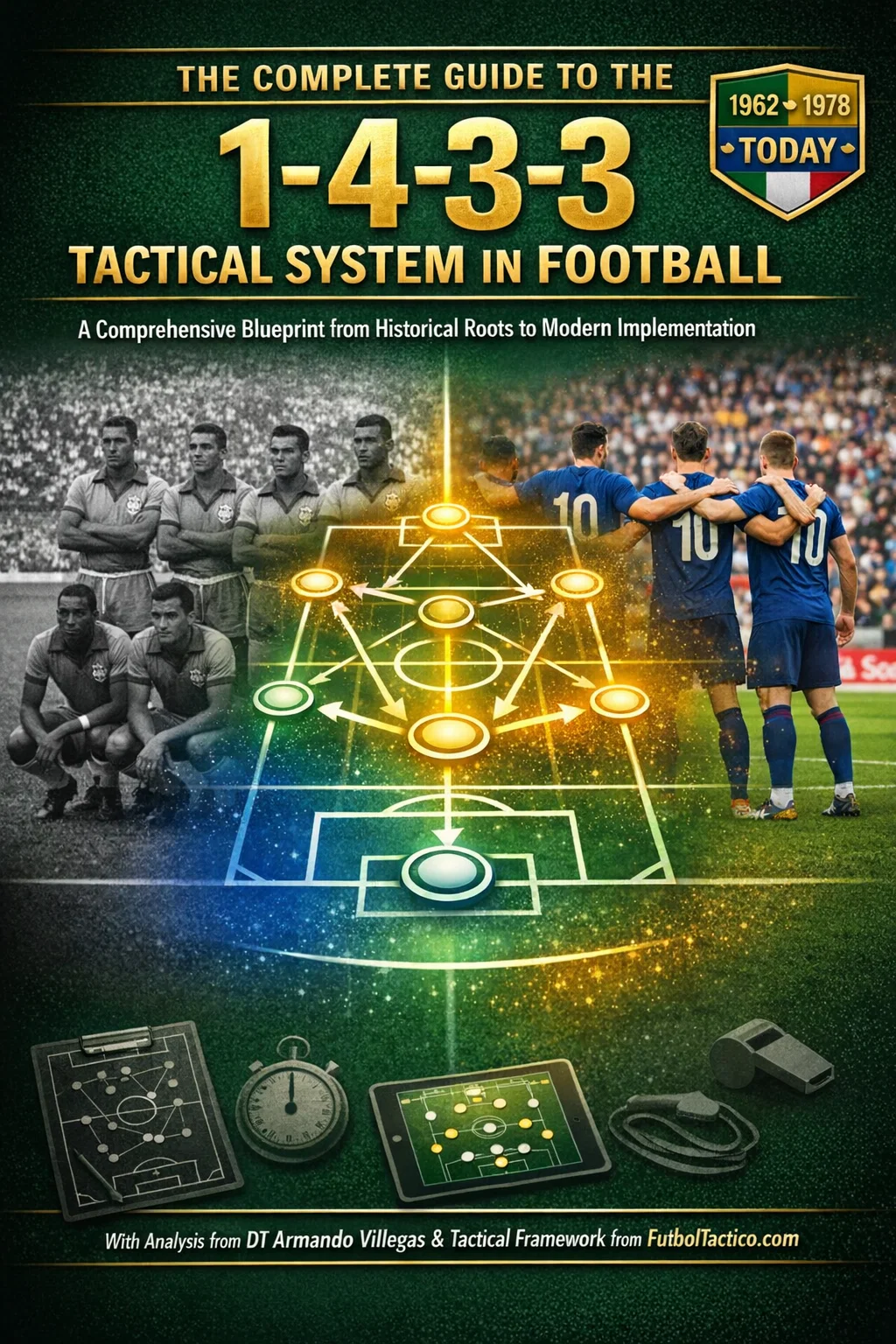
The 1-4-3-3 tactical formation represents one of football’s most influential and enduring systems. Since its revolutionary debut by Brazil in 1962, it has evolved into a sophisticated blueprint for offensive dominance. This definitive guide explores why this formation remains the gold standard for modern strategic excellence, connecting historical roots with elite professional applications.
Table of Contents
1. The Historical Brilliance of the 1-4-3-3 Tactical Formation
The journey of the 1-4-3-3 tactical formation began as a tactical pivot from the traditional 1-4-2-4. By dropping a forward into the midfield, teams achieved a revolutionary balance that offered both defensive security and a lethal attacking threat.
This evolution reached its zenith during the late 70s, as seen in the FIFA World Cup archives, setting the stage for the high-possession models used by legendary teams like Ajax and Barcelona. Today, it is the backbone of “Total Football” and “Juego de Posición” (Positional Play).
2. Structural Excellence: Organizing the 1-4-3-3 Tactical Formation
To achieve success, a coach must ensure flawless synchronization between the defensive, midfield, and attacking units.
The Disciplined Defensive Line in the 1-4-3-3 Tactical Formation
A robust defense in this system typically utilizes a “flat back four” or a “diagonal structure.” The goal is to minimize space between lines while ensuring that central defenders can step out to disrupt opposition possession.
- Key Principles: Interchangeable marking and coordinated pressing.
- Deep Dive: For more on organizing the backline, see our guide on Weekly Game Preparation.
The Midfield Engine: The Heart of the 1-4-3-3 Tactical Formation
The midfield trio is the tactical “brain” of the team. Most successful implementations utilize a Single Pivot to channel play and two advanced midfielders to penetrate the final third.
- The Regista Role: As discussed in Andrea Pirlo’s “My Football” Philosophy, the deep-lying playmaker is the conductor of this orchestra, ensuring numerical superiority in central areas.
3. Masterful Offensive Principles within the 1-4-3-3 Tactical Formation
The beauty of the 1-4-3-3 tactical formation lies in its ability to create and exploit wide areas through coordinated movement patterns.
Wide Attack Development and Mezzala Involvement
This formation excels at forcing play switches to exploit “weak-side” advantages. By utilizing Mezzali (advanced midfielders) for diversion movements, the system creates constant 2v1 overloads against opposition fullbacks.
- The 3-Element Combination: High-level attacks rely on the “Lateral Chain”—the synchronized movement of the fullback, interior midfielder, and winger. This concept is vital for breaking down low-block defenses, a strategy often analyzed by The Tactical Times.
Fullback Integration and Width Creation
One of the system’s key strengths is fullback participation. By overlapping beyond the ball line, fullbacks create the necessary width to dislocate defensive setups, a hallmark of modern elite coaching.
4. Modern Training Methodologies for the 1-4-3-3 Tactical Formation
Effective implementation requires specific training approaches that mirror match-day scenarios.
Proactive Recovery and Defensive Transitions
In the 1-4-3-3 tactical formation, forwards play a crucial defensive role. Using a high press to recover the ball within 5 seconds—a principle found in the FIGC Technical Sector manuals—ensures the team maintains pressure and prevents counter-attacks.
Training Progression Phases:
- Structural Understanding: Learning positional responsibilities.
- Unit Coordination: Connecting defense, midfield, and attack.
- Phase Integration: Mastering the transition from build-up to finishing.
Conclusion: The Inspiring Legacy of the 1-4-3-3 Tactical Formation
The 1-4-3-3 tactical formation continues to represent one of football’s most balanced and adaptable frameworks. From youth development to professional elite levels, it offers a complete toolkit for coaches who seek a quality game that produces scoring opportunities and dictates the tempo of the match.
Whether you are building from the back or pressing from the front, mastering this system is your path to the Road to Excellence.