

Table of Contents
Revolutionizing Youth Football: How Small-Sided Games Unlock Tactical Intelligence and Creativity
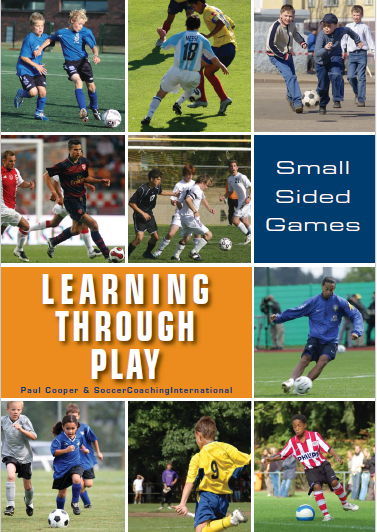
Modern football coaching is undergoing a massive paradigm shift. For decades, youth development was dominated by rigid, adult-structured drills, continuous running, and premature tactical lectures. Today, elite academies are looking backward to leap forward, embracing the chaotic genius of street football through Small-Sided Games (SSGs).
By reducing pitch sizes and team numbers, coaches can replicate the natural learning environment that birthed generations of football legends. As Zinedine Zidane famously noted, “Everything I have achieved in football is due to playing in the streets with my friends.”
Here is an analytical breakdown of how integrating SSGs into your curriculum accelerates spatial awareness, technical execution, and tactical intelligence.
The Philosophy: Why the Game is the Best Teacher
When children are placed in full-sized match formats too early, their technical development stalls. In an 11v11 match, a struggling player might only touch the ball a handful of times. In contrast, a structured 4v4 or 5v5 environment maximizes ball contact, forcing players to constantly problem-solve.
Key Benefits of Small-Sided Games:
- High-Frequency Ball Contact: Players receive constant opportunities to pass, dribble, shield, and shoot, accelerating technical mastery.
- Cognitive Load & Decision Making: The tight spaces of SSGs mimic a crowded midfield, forcing youth players to keep their heads up and read the game instinctively.
- Freedom to Fail: Without the heavy pressure of adult-driven match results, children play with spontaneity, creativity, and structural fluidity.
For a deep dive into elite academy structures, explore our comprehensive analysis on the 8 Secrets of PSV Eindhoven’s Youth Training Success.
3 Elite Small-Sided Games to Transform Your Training
Implementing the right constraints within a game teaches specific tactical principles automatically, without the coach needing to constantly interrupt play. Below are three highly effective variations adapted from historical tactical setups.
1. The Liverpool “Pass & Move” Game (U12 to Adult)
Inspired by Bill Shankly’s dominant 1970s and 1980s teams, this game focuses on high-intensity, short-passing metrics.
- Organization: A standard $40 \times 20$ meter pitch with two mini-goals.
- The Rule: The moment a player passes the ball, they must immediately move at least two yards in any direction (forward, backward, or sideways) to support the receiver.
- Tactical Objective: Eliminates static standing, improves body angles, and instills an instinctive one-touch passing rhythm.
2. The 6-Second Transition Game (U12 to Adult)
Modern football is defined by moments of transition. Modeled after elite counter-pressing systems, this drill teaches players how to handle the immediate aftermath of losing possession.
- Organization: Standard SSG pitch with standard mini-soccer goals.
- The Rule: When a team loses the ball, they have exactly 6 seconds to win it back through aggressive, coordinated pressing.
- Tactical Objective: If they succeed, they earn an immediate point. If they fail, they must quickly drop into a compact defensive block to limit central space.
3. The Arsenal “Give & Go” Game (U12 to Adult)
Designed to replicate the fluid, quick-combination play championed by Arsène Wenger, this drill utilizes neutral players to create numerical overloads.
       [Neutral Player 1 (Touchline)]
---------------------------------------------
|                                           |
|    Team A (4 Players) vs Team B (4)       |
|                                           |
---------------------------------------------
       [Neutral Player 2 (Touchline)]
- Organization: Standard pitch layout with 4v4 in the center and 2 neutral bounce players stationed on the touchlines.
- The Rule: The team in possession can use the touchline neutrals to create a 5v4 or 6v4 overload. Touchline players are limited to a single touch.
- Tactical Objective: Encourages overlapping runs, wall passes, and high-tempo attacking triangles.
For specific practice setups and layout diagrams, download our full resource on PSV Eindhoven Youth Team Training Sessions PDF to see how these spacing principles are applied in professional academies.
Structuring the Chaos: Practical Tips for Coaches
Transitioning from traditional drills to game-based coaching requires a deliberate step back. As Middlesbrough Academy Director Dave Parnaby notes, coaches must act as facilitators rather than dictators to avoid stifling natural talent.
| Feature | Traditional Drills | Small-Sided Games (SSGs) |
| Ball Touches | Low / Isolated | Extremely High / Contextual |
| Fitness Benefit | Linear / Monotonous | Match-Specific Conditioning |
| Tactical Context | Absent | Integrated into every second |
| Player Engagement | Low (Waiting in lines) | Maximum (Continuous action) |
When designing your sessions, always remember to maintain flexibility with your pitch sizes. If your players are struggling to retain possession, widen the pitch to afford them more thinking space; if you want to test their technical limits under extreme pressure, tighten the boundaries.
Expanding Your Coaching Toolkit
To truly master the nuances of youth development and access professional-grade tactical curriculums, check out the official UEFA Training Innovations and browse the developmental guidelines provided by the English Football Association (The FA) for grassroots excellence.
For a massive library of variations covering everything from ball mastery to cognitive game insight, read our ultimate guide detailing 55 Powerful Soccer Training Drills to Improve Ball Control, Speed, and Tactical Intelligence.
((