

7v7 Workshop for 10U Coaches: Building the Complete Player
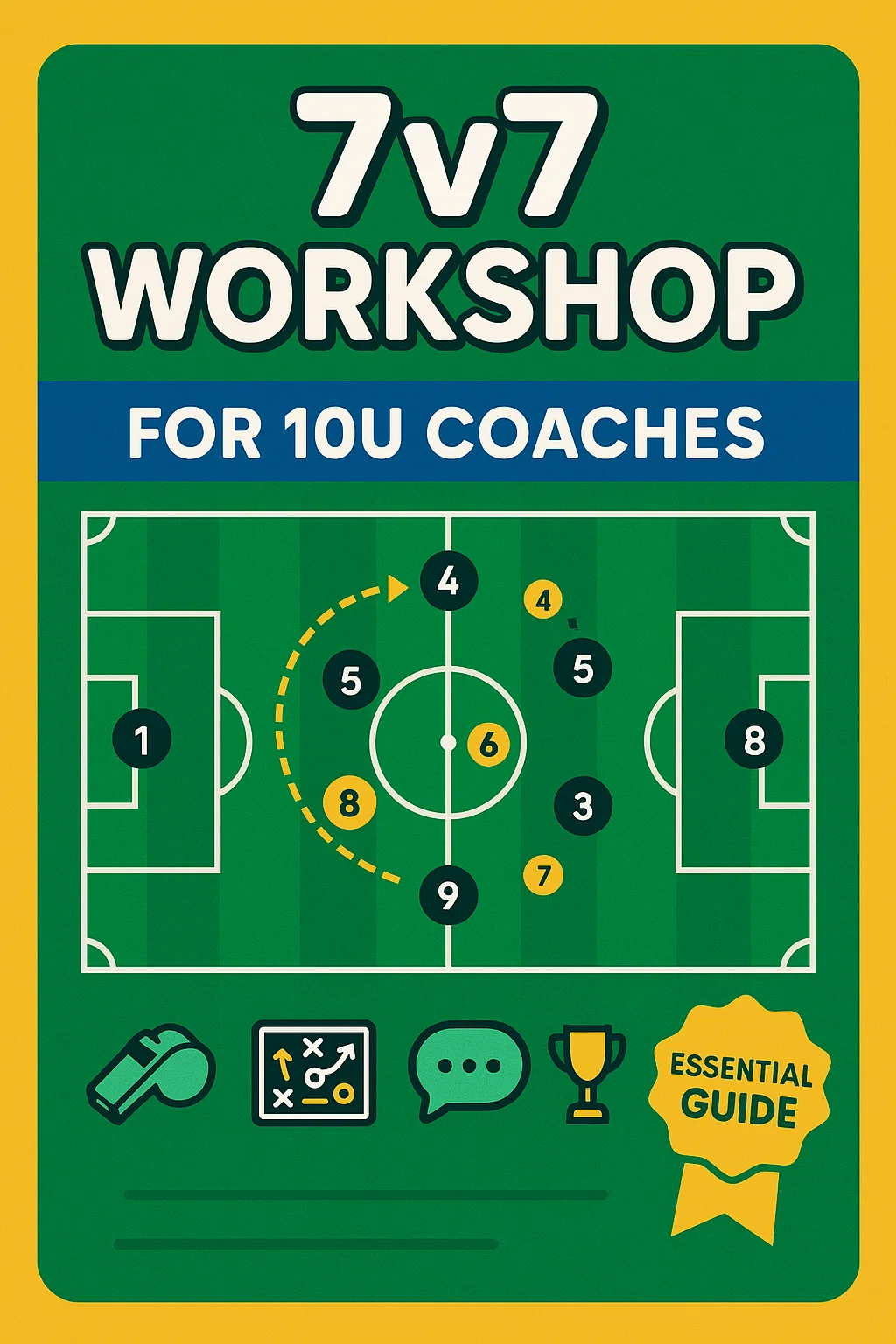
The 7v7 Workshop for 10U Coaches: Developing Intelligent Players and Building a Winning Philosophy
Introduction: Stepping onto the New Pitch
Welcome, dedicated coach, to the most exciting and formative stage in youth football: the transition to the 7v7 game. This is not merely a step up in numbers; it is a quantum leap in complexity, opportunity, and fun. For the 10U player, the larger pitch and reduced numbers represent their first true encounter with the beautiful game’s core strategic battlegrounds: space, time, and collective decision-making. Consequently, your role evolves from a primary instructor to a facilitator of understanding, a designer of engaging environments, and a mentor shaping both footballers and people.
This comprehensive workshop is designed to be your ultimate guide. We will move beyond isolated drills and delve into the holistic development of your team. We will explore the psychology of the 10-year-old athlete, deconstruct the 7v7 system, build a season-long curriculum, and master the art of session design. To equip you with professional-grade tools, this article integrates essential resources like the foundational UEFA B License Coaching Manual PDF. Our mission is clear: to empower you to build a team that is not only successful on the scoreboard but also technically proficient, tactically aware, and, most importantly, passionately in love with the game.
Section 1: Understanding the 10U Player: A Developmental Blueprint
Before we can effectively coach, we must first understand who we are coaching. A 10-year-old is not a mini-adult; they are at a unique and pivotal stage of development across several domains.
1.1 The Cognitive and Psychological Landscape
At this age, children are developing concrete operational thinking. They can understand rules, logic, and consequences more clearly, but their abstract thinking is still emerging. This means they can grasp basic tactical concepts (“spread out,” “support your teammate”) but will struggle with complex, layered instructions. Their attention spans are lengthening but still best served by dynamic, varied activities. Crucially, they are highly susceptible to praise and criticism; your feedback must be constructive and process-oriented, focusing on effort and improvement rather than innate talent or game outcomes.
1.2 Physical Capacities and Motor Skill Windows
Physically, 10U players are often in the midst of growth spurts, which can temporarily disrupt coordination and balance. This is a critical window for developing fundamental motor skills and technical proficiency. Their aerobic capacity is improving, but they are naturally built for high-intensity, intermittent activity—perfect for the stop-start nature of football. Therefore, training must prioritize a high volume of ball touches within a fun, game-like context. Utilizing resources like the Warm-up Exercises with Ball PDF ensures every minute of practice contributes to both physical preparation and technical development.
1.3 The “Fun-damental” Principle: Keeping the Love for the Game Alive
Above all, the 10U environment must be enjoyable. The primary reason children drop out of sports is that they cease to be fun. Every decision you make—from the activities you design to the tone of your voice—should be filtered through this principle. The game itself is the best teacher, so our job is to create a framework where the joy of playing, competing, and improving is at the forefront. Integrating a resource like the 60 Training Games PDF into your planning is an excellent strategy to ensure your sessions remain engaging and player-centered.
Section 2: The 7v7 System – More Than Just Formation
Many coaches fall into the trap of seeing a formation as a static picture. In reality, a formation is merely a starting point; it’s the team’s understanding of how to play within and, more importantly, between those lines that defines success.
2.1 Analyzing the 2-3-1 Formation: Balance and Fluidity
The 2-3-1 is widely regarded as the ideal formation for introducing 7v7 tactics. It provides natural balance, clear defensive and midfield lines, and a logical structure for players to understand their roles.
- The Back Two (Defenders): Their primary role is to defend the central channel and learn to work as a partnership. One can engage the ball-carrier while the other provides cover.
- The Midfield Three (The Engine Room): This is the heart of the team. The central midfielder acts as the pivot, linking defense and attack, while the wide midfielders must learn to attack in support of the forward and defend in support of the full-backs. This is where understanding of width and depth truly begins.
- The Lone Forward (The Focal Point): This player learns to hold up the ball, bring others into play, and make penetrating runs behind the defense.
2.2 Principles of Play: The Foundation of Tactical Understanding
Beyond formation, players must be introduced to the game’s core principles. These are the “why” behind the “what.” For a deeper dive, the Principles of Play Attacking PDF is an invaluable resource. The key principles to introduce at this age are:
- Penetration: Can we play forward?
- Width: How do we use the full width of the pitch to create space?
- Support: How can players position themselves to offer passing options?
- Mobility: How can players’ movement unbalance the defense?
2.3 Introducing Positional Rotation and Flexibility
While having a base structure is crucial, players must not become rigidly fixed to positions. Encouraging intelligent rotation, especially among the midfield three and the forward, helps develop more intelligent, versatile players. For example, a wide midfielder should feel comfortable swapping positions with the central midfielder if the opportunity arises. This fosters a better understanding of the game as a whole.
Section 3: The Art of Session Design for 10U Players
A well-structured session is the vehicle for all learning. It should be progressive, engaging, and replicate the demands of the actual game.
3.1 The Four-Component Session Model
Every training session should follow a logical progression:
- The Introduction (Warm-up): This should be with a ball from the first minute. The Warm-up Exercises with Ball PDF provides excellent activities that prepare the body and mind while developing technical skills.
- The Skill Acquisition Phase (Unopposed/Low Pressure): This is where you introduce or rehearse a specific technique or tactical concept in a controlled environment.
- The Skill Application Phase (Opposed/High Pressure): Here, you add pressure—first from passive defenders, then from active opponents—in a conditioned game that encourages the use of the skill you’re working on.
- The Final Product (The Game): Always finish with a small-sided or 7v7 game. The only condition is to reinforce the session’s topic. This is where learning is consolidated.
3.2 Building a Season-Long Curriculum
Your weekly sessions should not be random; they should build upon each other within a larger, season-long plan. A resource like The Training Plan or broader Soccer Training Programs can help you structure this macro-view. A sample curriculum block might look like this:
- Weeks 1-4: Focus on individual technical skills (passing, receiving, dribbling) and basic principles of attack (support, width).
- Weeks 5-8: Focus on individual and small-group defending, and principles of defense (pressure, cover).
- Weeks 9-12: Focus on team shape in the 2-3-1 formation and transitioning from attack to defense.
For more advanced structural ideas, you can explore the Essential 3-5-2 and 3-4-3 Training Exercises PDF, which can be adapted to introduce different tactical shapes later in the season.
Section 4: Technical Proficiency: Building the Foundation
Technical ability is the language of football. Without it, tactical ideas cannot be executed.
4.1 Mastering the Essentials: Passing and Receiving
The quality of a team’s passing and receiving is the primary determinant of its success. Drills should focus on using both feet, receiving under pressure, and playing passes with the correct weight and accuracy. The UEFA B License Coaching Sessions PDF contains a wealth of proven exercises for developing these core skills in a progressive manner.
4.2 Dribbling and 1v1 Situations
Encourage creativity and bravery in 1v1 situations. Players should practice changing speed and direction, using feints, and protecting the ball. The 60 Training Games PDF is packed with fun, competitive games that naturally develop these abilities in an engaging way.
4.3 Shooting and Finishing
Every session should include an element of shooting. Focus on technique (body position, striking the ball) but also on the mentality of being eager to shoot and following up rebounds.
Section 5: Learning from the Best: A Glimpse into Professional Academies
To elevate your coaching, it’s invaluable to understand how professional clubs approach development at this age level.
5.1 The Academy Philosophy: Long-Term Development
Top academies, like those profiled in the Sheffield United F.C. U14 Academy and Leicester City Football Club Academy PDF, prioritize long-term athlete development over short-term results. Their focus is on technical mastery, tactical understanding, and personal growth within a highly supportive and challenging environment. Studying these documents can provide insights into session structure, coaching methodology, and the overall player pathway.
5.2 Philosophical Influences: Marcelo Bielsa’s Approach
While advanced, understanding different football philosophies can enrich your own coaching. The intense, attacking, and possession-based principles outlined in Marcelo Bielsa’s Football Philosophy PDF can inspire drills and concepts around high pressing, vertical passing, and constant movement—all adaptable in a simplified form for the 10U level.
Section 6: Continuing Your Coaching Education
The best coaches are perpetual students of the game. Your development is just as important as your players’.
6.1 Pursuing Formal Qualifications
Consider advancing your knowledge through formal courses. The pathway often includes:
- AFC B Diploma Coaching Course Certificate PDF
- UEFA A Licence: The Complete Coach’s Guide PDF
- UEFA Pro License Course PDF
These resources offer a glimpse into the curriculum and demands of these elite qualifications.
6.2 Utilizing Session Planning Tools
Never underestimate the power of a well-thought-out plan. The UEFA A Coaching Session Plans provide a template for how to structure sessions with clear objectives, key coaching points, and logical progressions.
Conclusion: Your Legacy as a 10U Coach
The journey of a 10U coach is one of profound impact. You are not just teaching children how to play a formation; you are teaching them how to solve problems, work as a team, overcome adversity, and find joy in collective achievement. The lessons learned on your pitch—about resilience, respect, and responsibility—will extend far beyond the touchlines and last long after the final whistle of the season.
Remember, your ultimate success is not measured by a trophy cabinet, but by the number of players who still love the game next season, the players who demonstrate sportsmanship without being told, and the players who, years later, recall your guidance as a positive force in their lives.
Continue to learn, to adapt, and to be the coach who sees the potential in every child. Use the tools provided here, from the foundational UEFA B License Coaching Manual PDF to the practical 60 Training Games PDF, to build your knowledge and inspire your players. For further learning, explore the wealth of information available on trusted external platforms like The FA’s Learning Resources and UEFA’s Training Ground.
Now, go and build something great. The future of the game is in your hands.