

GUIDE BOOK FOR COACHES OF 7v7: Developing Young Players Through the Transitional Format
GUIDE BOOK FOR COACHES OF 7v7: Developing Young Players Through the Transitional Format
Introduction: Embracing the 7v7 Development Window
Welcome to the transformative world of 7v7 soccer coaching. This format represents one of the most crucial developmental phases in a young player’s journey, bridging the gap between fundamental technical training and the complex tactical demands of 11v11 football. As a coach in the Watertown Youth Soccer program, you’re not just teaching soccer – you’re shaping young minds, building character, and fostering a lifelong love for the beautiful game.
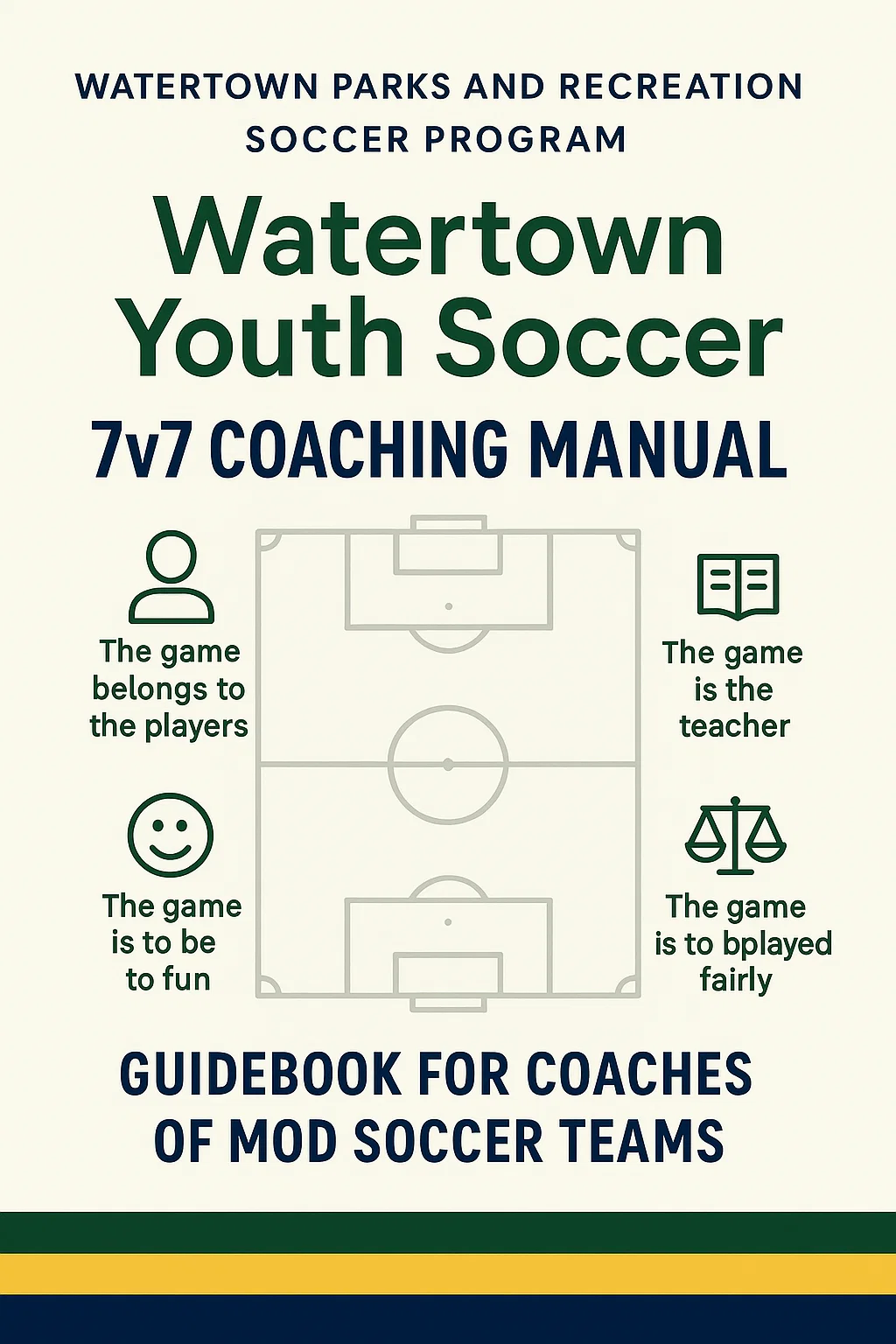
The 7v7 format provides the perfect environment for implementing our core philosophy: that the game belongs to the players, serves as the ultimate teacher, must remain fun, and should always be played fairly. This comprehensive guide builds upon these foundational principles while incorporating modern coaching methodologies from world-class resources like the UEFA B License Coaching Manual PDF, adapted specifically for the developmental needs of young players in the 7v7 format.
Throughout this manual, we’ll explore how to create training environments that challenge players appropriately while maintaining the joy and excitement that first attracted them to the sport. We’ll balance technical development with tactical introduction, physical growth with psychological support, and individual creativity with team understanding.
Section 1: Understanding the 7v7 Development Phase
1.1 The Critical Transition: From Small-Sided Games to Structured Play
The move to 7v7 soccer represents a significant milestone in player development. This format introduces young athletes to more complex tactical concepts while maintaining the high involvement rates that characterize smaller-sided games. Understanding this transitional nature is crucial for effective coaching.
During this phase, players experience their first encounter with formal positions, expanded field dimensions, and more sophisticated game dynamics. However, it’s vital to remember that they’re still children learning the game. The most effective coaches balance structure with freedom, guidance with exploration, and correction with encouragement.
The 7v7 format naturally teaches players about spatial awareness, transition moments, and basic tactical principles. As coaches, our role is to facilitate this learning through well-designed sessions and appropriate interventions. The UEFA A Licence: The Complete Coach’s Guide PDF provides excellent insights into creating developmentally appropriate learning environments for young players.
1.2 Age-Appropriate Expectations and Learning Objectives
Setting realistic expectations forms the foundation of effective coaching at this level. Players will demonstrate varying levels of technical proficiency, tactical understanding, physical development, and emotional maturity. Our coaching must accommodate this diversity while challenging each player appropriately.
Primary learning objectives for the 7v7 phase include: developing technical consistency in fundamental skills, introducing basic tactical concepts like width and support, fostering positive team dynamics and communication, and maintaining high levels of enjoyment and engagement. These objectives align with the Watertown philosophy that “the game is the teacher” – we create the conditions for learning rather than imposing rigid structures.
Furthermore, we must recognize that players develop at different rates physically, technically, and psychologically. Our coaching approach should celebrate individual progress while fostering team cohesion. Resources like the Leicester City Football Club Academy PDF demonstrate how top academies accommodate individual development pathways within team structures.
Section 2: Implementing the Watertown Philosophy in 7v7 Coaching
2.1 Putting Players First: A Child-Centered Approach
The first tenet of our philosophy – “the game belongs to the players” – requires a fundamental shift in coaching mindset. Rather than being directors who control every action, we become facilitators who create environments where players can explore, discover, and learn through the game itself.
Implementing this approach involves: encouraging player decision-making rather than providing constant instruction, asking questions that prompt thinking rather than always giving answers, allowing players to solve problems themselves during games, and creating training environments that replicate game conditions. This methodology develops intelligent, independent players who understand the game rather than just following commands.
Additionally, we must respect that children participate for various reasons – social connection, physical activity, skill development, or simply fun. Our coaching should acknowledge these diverse motivations while gradually deepening each player’s understanding and appreciation of the game. The UEFA B License Coaching Sessions PDF provides excellent examples of player-centered training activities that foster decision-making and problem-solving.
2.2 Making Soccer Fun: The Engagement Principle
The third element of our philosophy – “the game is to be fun” – is both obvious and often overlooked in competitive environments. Maintaining enjoyment doesn’t mean avoiding challenge or competition; rather, it means creating training environments and game-day experiences that players anticipate with excitement.
Fun in soccer comes from various sources: the joy of mastering new skills, the excitement of competition, the camaraderie of teammates, the satisfaction of effort, and the sheer pleasure of movement. Effective coaches incorporate all these elements through varied sessions, positive reinforcement, appropriate challenges, and celebration of effort as well as outcome.
Practical strategies for maintaining enjoyment include: using a variety of activities from resources like the 60 Training Games PDF, incorporating player choice in some activities, keeping players active rather than standing in lines, focusing on process over outcome, and ensuring every player feels valued regardless of ability level.
Section 3: Technical Development in the 7v7 Format
3.1 Fundamental Skill Priorities for 7v7 Players
Technical proficiency provides the foundation for all other aspects of player development. Without solid technique, players cannot execute tactical ideas, express creativity, or experience the full joy of the game. Our technical focus should prioritize quality repetition within game-realistic contexts.
Key technical priorities include: ball mastery and comfort in possession, passing and receiving with both feet, dribbling and 1v1 situations, shooting technique and confidence, and introduction to heading (with proper safety emphasis). These skills should be developed progressively, starting with technical correctness and advancing to execution under pressure.
Each training session should include dedicated technical development through activities that provide high repetition while maintaining engagement. The Warm-up Exercises with Ball PDF offers excellent activities that efficiently develop technical skills while preparing players physically and mentally for training.
3.2 Integrating Technical Development into Game-Like Contexts
Isolated technical training has value, but technical development truly accelerates when practiced within game-like environments. The most effective coaches design activities that simultaneously develop technical skills, tactical understanding, and decision-making.
Effective integration strategies include: using small-sided games that naturally encourage technical repetition, incorporating technical conditions into possession games, creating 1v1, 2v1, and 2v2 scenarios that replicate game situations, and designing practices that transition between technical repetition and immediate application.
This integrated approach ensures that technical development directly translates to game performance. Furthermore, it aligns with our philosophy that “the game is the teacher” – players learn techniques within the context where they’ll be used. The Soccer Training Programs provides comprehensive frameworks for integrating technical development into holistic training sessions.
Section 4: Tactical Introduction Through the 7v7 Lens
4.1 Basic Formations and Player Roles
The 7v7 format provides the perfect platform for introducing basic tactical concepts. The most common formation – 2-3-1 – offers natural balance and clear positional relationships that young players can understand and execute.
In the 2-3-1 formation: the two defenders learn to work as a partnership, covering and supporting each other; the three midfielders experience different roles (central connector and wide supporters); the single forward learns to play as a target while also creating space for midfield runners. This structure introduces players to basic positional responsibilities while maintaining flexibility.
It’s crucial to remember that positions should not become prisons. Players should experience different roles throughout the season, developing versatility and a broader understanding of the game. The Essential 3-5-2 and 3-4-3 Training Exercises PDF offers valuable insights into different tactical structures that can be adapted for 7v7 as players advance.
4.2 Introducing Principles of Play
Beyond formations, 7v7 provides the ideal context for introducing the fundamental principles that underpin all football tactics. These concepts help players understand the “why” behind tactical decisions.
Key principles to introduce include: penetration (playing forward when possible), width (using the full field in attack), depth (creating supporting angles), mobility (moving to create options), and improvisation (creative problem-solving). These principles should be introduced gradually through guided discovery and game-like scenarios.
The Principles of Play Attacking PDF provides excellent frameworks for teaching these concepts in age-appropriate ways. By focusing on principles rather than rigid patterns, we develop intelligent players who can adapt to various game situations.
Section 5: Effective Session Planning for 7v7 Teams
5.1 The Four-Component Session Model
Well-structured training sessions maximize learning while maintaining engagement and enjoyment. Each session should follow a logical progression that prepares players technically, tactically, and physically for the demands of the game.
The four-component model includes: introduction (arrival activity and warm-up), skill development (focused technical/tactical work), skill application (game-like scenarios), and conclusion (conditioned game and cool-down). This structure ensures a smooth transition from simple to complex, from technical repetition to tactical application.
Each component serves specific purposes: the introduction activates players physically and mentally, skill development provides focused repetition, skill application transfers learning to game contexts, and the conclusion reinforces learning through the game itself. The UEFA A Coaching Session Plans offers detailed templates for designing sessions with appropriate progressions and timing.
5.2 Seasonal Planning and Curriculum Integration
Effective coaching requires looking beyond individual sessions to the broader seasonal plan. A well-designed curriculum ensures progressive development across technical, tactical, physical, and psychological dimensions throughout the season.
A sample seasonal structure might include: early season focus on fundamental skills and team cohesion, mid-season emphasis on tactical concepts and game understanding, late season refinement of skills and tactical execution. This progression ensures players build capabilities sequentially without being overwhelmed.
Additionally, each mesocycle (4-6 week block) should have specific learning objectives that build toward seasonal goals. The The Training Plan provides excellent frameworks for structuring seasonal development across different age groups and ability levels.
Section 6: Game Day Management and Coaching
6.1 Pre-Match Preparation and Warm-Up
Game days represent both the culmination of weekly training and valuable learning opportunities. Effective preparation begins before players arrive at the field and sets the tone for a positive experience.
Key pre-match elements include: communicating clearly with parents about logistics, creating a structured arrival routine, implementing an effective warm-up using activities from the Warm-up Exercises with Ball PDF, delivering a simple, focused team talk, and establishing clear expectations for behavior and effort.
The warm-up should physically prepare players while reinforcing technical skills and tactical concepts from training. It should be efficient, engaging, and transition smoothly into the game start. Most importantly, it should maintain the positive, player-centered approach that characterizes our training sessions.
6.2 Sideline Behavior and In-Game Coaching
Our behavior during games significantly impacts player experience and development. The sideline should be a place of positive support and appropriate guidance, not pressure and constant instruction.
Effective sideline behavior includes: focusing on encouragement rather than criticism, allowing players to solve problems themselves, providing brief, clear instructions during natural breaks, modeling respect for officials and opponents, and maintaining perspective about results within the broader development process.
Additionally, we should rotate players through different positions, ensure equal playing time for all participants, and use substitutions as teaching moments rather than punishments. These practices reinforce our philosophy that development takes precedence over winning. Studying approaches from top academies like those in the Sheffield United F.C. U14 Academy can provide valuable insights into player development during competitive environments.
Section 7: Player Development Beyond Technical Skills
7.1 Psychological Development and Mental Skills
The 7v7 years represent a crucial period for developing the psychological attributes that support both football success and personal growth. Our coaching should intentionally foster these qualities alongside technical and tactical development.
Key psychological skills to develop include: resilience and ability to bounce back from mistakes, concentration and focus during training and games, emotional control and channeling emotions productively, confidence through mastery and positive reinforcement, and intrinsic motivation and love for the game itself.
These qualities develop through carefully designed training environments that challenge players appropriately, coaching language that emphasizes process and effort, and competitive experiences that balance success with manageable failure. The approach shares similarities with methodologies outlined in Marcelo Bielsa’s Football Philosophy PDF, particularly regarding mental fortitude and concentration.
7.2 Social Development and Team Culture
Football provides a powerful context for social development, teaching children invaluable lessons about teamwork, communication, and relationships. As coaches, we should intentionally foster positive team cultures that extend beyond the pitch.
Key social development areas include: communication skills with teammates and coaches, cooperation and working toward shared goals, leadership opportunities and responsibilities, respect for diversity and different abilities, and conflict resolution and managing disagreements constructively.
These social skills develop through: team-building activities, shared team responsibilities, modeling and reinforcing respectful communication, creating inclusive environments where all players feel valued, and addressing social dynamics proactively rather than reactively.
Section 8: Coach Development and Continuing Education
8.1 Self-Reflection and Coaching Improvement
The most effective coaches are perpetual students of the game who continuously reflect on and improve their practice. Regular self-assessment ensures we’re providing the best possible experience for our players.
Effective self-reflection includes: reviewing sessions against planned objectives, seeking feedback from players and fellow coaches, video analysis of training activities and game interactions, reading and research into coaching methodologies, and attending coaching education opportunities.
Additionally, we should regularly revisit our coaching philosophy to ensure alignment with the Watertown principles. The AFC B Diploma Coaching Course Certificate PDF provides insight into formal coaching education pathways that can deepen our understanding of player development.
8.2 Building a Coaching Community
No coach develops in isolation. Creating networks with fellow coaches provides support, shared learning, and consistent application of our philosophy across the program.
Building coaching community involves: regular coach meetings to discuss challenges and solutions, peer observation and constructive feedback, shared resources and best practices, mentoring relationships between experienced and new coaches, and collaborative problem-solving for program-wide issues.
This collaborative approach ensures that all Watertown players receive a consistent, high-quality experience regardless of their specific team or coach. It also models the teamwork and continuous improvement we seek to develop in our players.
Conclusion: The Legacy of 7v7 Coaching
The 7v7 coaching journey represents far more than teaching soccer skills and tactics. As Watertown coaches, we have the privilege and responsibility of shaping young people’s relationship with sport, physical activity, and themselves. The impact of our coaching extends beyond goals scored and games won to the lifelong lessons about effort, teamwork, resilience, and joy.
By embracing the Watertown philosophy that the game belongs to the players, serves as the teacher, must remain fun, and should be played fairly, we create development environments that nurture both skilled footballers and well-rounded individuals. The approaches outlined in this guide – from technical development frameworks to game day management strategies – provide the practical tools to implement this philosophy effectively.
As you continue your coaching journey, remember that your most powerful teaching tool isn’t found in any drill or tactic – it’s the positive relationships you build with players, the enthusiasm you bring to each session, and the belief you instill in every child that they can grow and improve. Continue to develop your craft through resources like the UEFA Pro License Course PDF and trusted external platforms like The FA’s Learning Hub (https://learn.englandfootball.com) and UEFA Training Ground (https://www.uefa.com/trainingground/).
The future of Watertown soccer – and more importantly, the future of the young people we serve – depends on the quality of our coaching today. By implementing the principles in this guide with passion, patience, and perspective, you’re not just building better soccer players – you’re building better people who will carry the lessons learned on your pitch throughout their lives.
This guide aligns with the Watertown Parks and Recreation Soccer Program philosophy and incorporates best practices from leading football development organizations worldwide. The program welcomes feedback and continuous improvement suggestions from all coaches, parents, and participants.